
Thought Leadership
It is indeed tragic that most Indians across generations are groomed from their formative years to subscribe to a flawed interpretation of the Karma theory and the caste system built on a fatalistic premise, which assumes without second thought that whatever happens (or does not happen) is the outcome of our good or bad karmaDr. B. S. Ajaikumar
Trained Not to Think - Part II
- Date: 2026-04-28 03:49:52
- Author: Dr. BS Ajaikumar

For centuries, the powerful have kept ordinary people in check through a simple ploy: stop them from thinking. Teachers penalised curiosity. Priests highlighted how suffering was God’s will. Politicians kept citizens fearful and divided. The nuclear tool was control. The consequence was compliance.
That system is still in vogue. It has simply found a far more powerful engine: Artificial Intelligence.
There was a time when an unanswered question was an invitation to search, to reflect, to arrive at an insight uniquely our own, whether right or wrong was another matter. We have long surrendered that internal search engine to Google search engine without a fight, and without any thought to what we lost in the process. Neuroscience calls it cognitive offloading. When the brain believes an external system will answer reliably, it stops maintaining that capacity itself. The muscle atrophies.
What Google began, Gen AI is accelerating, handing us conclusions sans the exploratory voyage. We are becoming more informed and less wise. Our smartphones are getting smarter, we are getting dumber.
No wonder, governments, corporations, religious institutions, and academic bodies have caught hold of an extraordinary tool. You do not need to silence people anymore. Just keep them busy. Give them an AI that thinks on their behalf, and they will hand over their minds willingly, and they will be grateful in doing so. What a win-win for the powers that be.
Gen AI tools now help people decide what to eat, whom to date, how to vote, what to believe, and how to grieve. From the trivial to the life-changing, the machine steps in never to get out. And with every decision it absorbs, the human capacity to reason or reflect is quietly being demolished, piece by piece.
Algorithms now decide what news you see, feeding you content that confirms what you are already inclined to believe. One no longer needs to think his or her position through. One simply reacts. A population that reacts is easy to lead. Politicians love that.
Every time AI recommends your next purchase, playlist, or meal, it removes a moment of choice. Choice requires judgment. Judgment requires thought. Remove enough of those moments and you have a consumer who does not decide, only follows. This is not convenience. It is the industrialisation of dependency. Business entities want that.
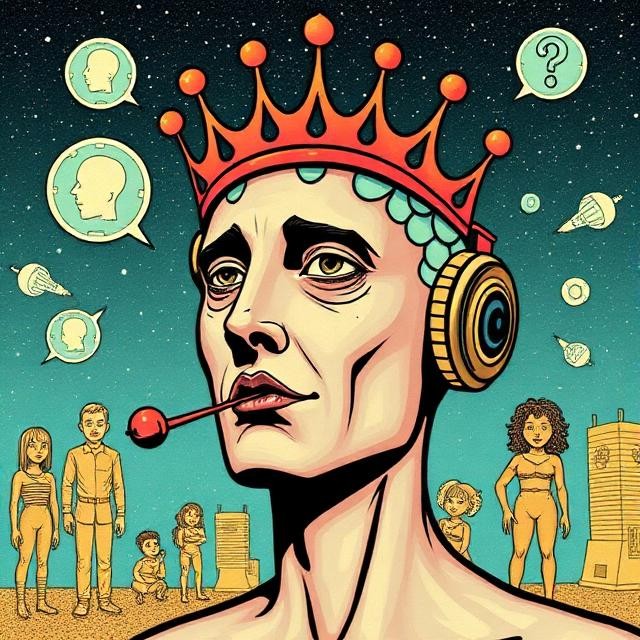
When students use AI to write their essays and solve their problems, they skip the one thing education was always meant to deliver: the struggle of working something out for yourself. That struggle, which is frustrating, slow, and uncertain, is where real thinking is born. Bypass it long enough and you produce graduates with qualifications but without the capacity to question. Academia promotes that.
AI now offers spiritual guidance, moral advice, and emotional comfort around the clock. The authority once held by the priest or the spiritual Guru is quietly migrating to a chatbot. People are surrendering their deepest questions to a machine, and receiving confident, frictionless answers in return. No enigma. No probe. No growth. Religious institutions ensure that.
The generation growing up today faces something unprecedented. Every older system of control required effort: a teacher had to shame the child, a ruler had to build propaganda infrastructure, a priest had to hold a community’s fear over generations. AI does all of this simultaneously, instantly, at a global scale, and with a smile. It is frictionless subjugation.
The child who was once told to sit down and stop questioning is now never told anything so harsh. She is simply handed a device that answers before the question is fully formed. The silence is the same. Only the method has changed.
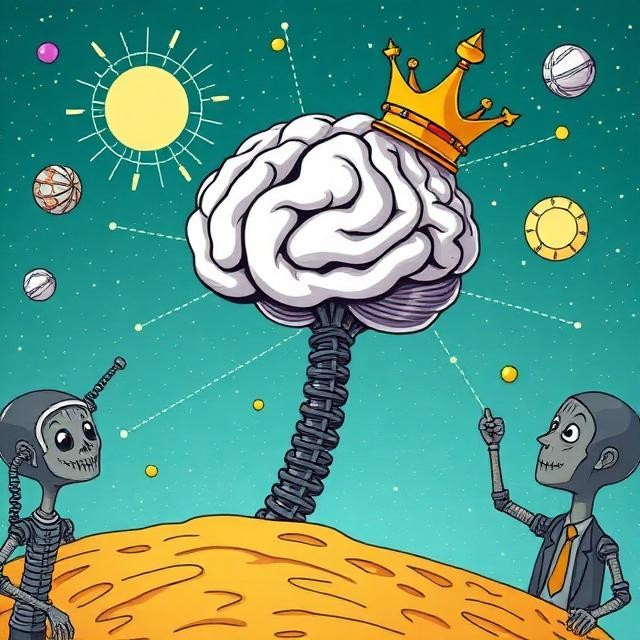
It is not difficult to see how awareness is the only antidote to this chronic and lifelong ailment. Not rejection of technology, but a fierce insistence on using it only as an enabling tool, not as a replacement for the self.
The establishment has always feared one thing above all others: a person who thinks for himself or herself. Not the protestor in the street, not the critic on a platform, but the quiet, sovereign individual who has learned to sit with a question long enough to arrive at an answer that is entirely, irreducibly her own. That person cannot be algorithmically managed. That person cannot be fed a conclusion and made to call it a conviction. Every system of control, from the feudal to the digital, has been architected, consciously or not, around the prevention of precisely this kind of person.
If we turn the tables, and we surely can, AI becomes something the powerful never intended it to be: an enabler of independent thought rather than a substitute for it. Used wisely, it can do what the best teachers always wished they had more time to do. It can surface ideas from across history and cultures that an individual would never have encountered alone. It can present multiple sides of an argument without demanding allegiance to any one of them. It can ask the question back, rather than simply answering it, holding up a mirror to the mind instead of replacing it.
Used this way, AI can nurture what centuries of institutional conditioning have worked hardest to suppress: the deeply human capacities for introspection and reflection. It can give a first-generation student in a remote village access to Socratic dialogue. It can give the overworked professional a moment of structured self-examination she would never otherwise find. It can give the doubting believer a space to ask the question her community has always told her is forbidden. In each of these moments, it does not think for the person. It creates the conditions in which the person remembers how to think.
A renaissance is nothing more than a civilisation remembering its own capacity for wonderment. If AI can seed that capacity, the most powerful tool ever built for control will have become the most powerful tool ever built for liberation. The hope for a better tomorrow can lead us to AI-enabled thought and action, provided we are awake to the sunrise possibilities.